1990
for
String quartet: two violins, viola and cello
Aaron Jay Kernis

Lark String Quartet

1990 Chamber Music Competition

November 13, 1990

Aaron Jay Kernis is a Pulitzer Prize and Grammy Award-winning composer and a member of the Yale School of Music faculty. His orchestral, chamber, and vocal works have been commissioned by leading performers and institutions. He has also helped develop programs for emerging composers in Minnesota and Nashville.
Kernis's program note connects the quartet's Classical forms with his interest in melody, harmonic expression, and the medieval image of heavenly singing.

Aaron Jay Kernis is an American composer whose music is performed by orchestras, chamber groups, and soloists internationally. Born in Philadelphia, he began with violin lessons, taught himself piano at twelve, and started composing the following year. He studied at the San Francisco Conservatory, Manhattan School of Music, and Yale with teachers including John Adams, Charles Wuorinen, and Jacob Druckman. His honors include the Pulitzer Prize, Grawemeyer Award, Nemmers Prize, and a Grammy Award. Kernis has taught at the Yale School of Music since 2003 and has played a substantial role in programs supporting emerging composers, including the Minnesota Orchestra Composer Institute and Nashville Symphony Composer Lab. His commissioners include Renée Fleming, Joshua Bell, and the New York Philharmonic.
I believe that a good piece of music should not need words to be described, so I hope that listeners will find these words superfluous in retrospect. But I would like to provide some background on some of the ideas and influences in this work.
Composing this quartet has been an exhilarating experience for me. I have wanted to write a quartet for years, and hence, was delighted when the Lark Quartet asked me to provide one for their Naumburg commission. But at the time I could not have imagined the sense of growth and pure pleasure that I have felt during its composition.
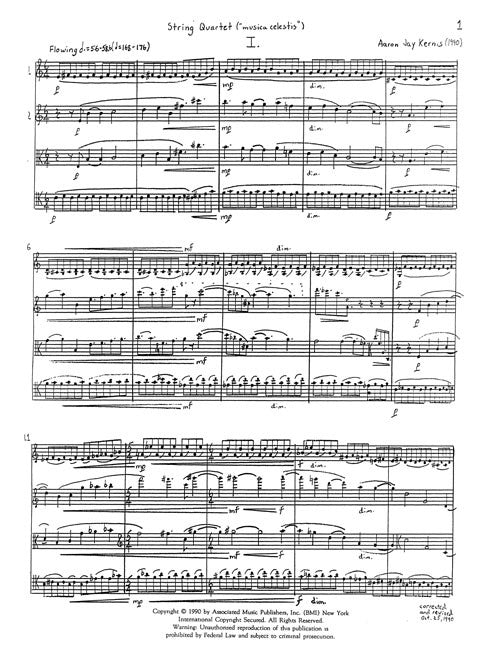
The form of the work is based on the string quartet model from the classical period—that is, in four movements: I. Sonata Form; II. Slow Movement; III. Scherzo with Trio; and IV. Rondo. This seems ordinary and quite basic, but if anyone had told me five or even two years ago that I’d write a classically structured work in the future, I’d have suggested (politely) that they see a helpful and friendly doctor. This quartet follows on the heels of my Symphony in Waves, written last year for the Saint Paul Chamber Orchestra, and for which the same remark holds true in regard to symphonic form. (Not for me, thank you). I’d felt traditional forms were outmoded and unapplicable to the music of our time.
But I’ve been gradually realizing that the music I keep on going back to—the music I really love—was written before 1945 and especially before 1911. I love the emotional inclusiveness of music of the past and have grown weary of the intellectualization that has limited the expression and communicativeness of so much music in this century. I want everything to be included in music: soaring melody, consonance, tension, dissonance, drive, relaxation, color, strong harmony, and form—and for every possible emotion to be elicited actively by the passionate use of those elements. This brings us back to the quartet.
As I began writing it, I found that the musical ideas that I chose to work with demanded extensive development and a well-shaped harmonic basis for that development. This led me, with great reservations at first and even greater disbelief, to the use of sonata form and caused me to confront using all the above elements head on, at once, in this abstractly formed composition. This felt especially new to me since so much of my work in the past derived its inspiration from images or texts. What convinced me to use the form, however, was the organic way that it developed from the musical ideas themselves.
The form of the first movement follows the traditional exposition-development-recapitulation “formula.” Unlike older sonata movements, most of the conflict and development occurs in the exposition and recap. The development section here is harmonically relaxed and mostly lyrical, acting as an extended interruption between the two larger sections. For those interested in a more detailed view of the first movement’s form, see below (others may skip without fear to the next paragraph).
I. Exposition: Theme 1 (alternates between pairs of instruments). Contrasting Section (Rhythmic Music A) ending in Climax on Theme 1 variant—transition to Theme 2 (solo viola, than solo violin 1). Rhythmic Music B (variant of end of first climax). Climax with Theme 1 variant. Closing Section.
II. Development: Transition. Four solos which develop Theme 1 (separated by brief contrasting sections). Re-Transition.
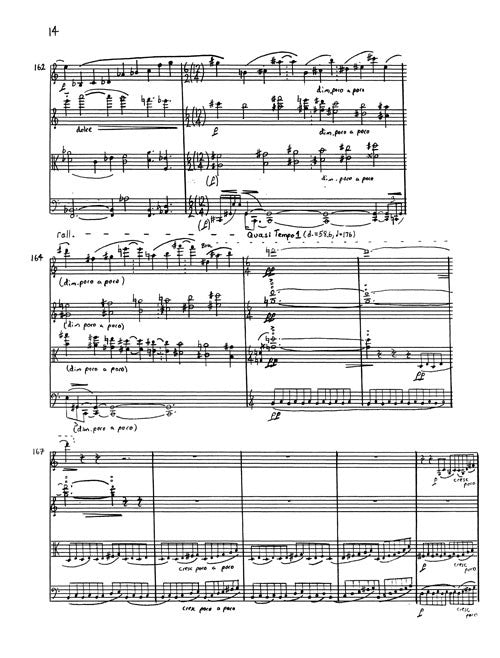
III. Recapitulation: Theme 1 (shortened and varied). Contrasting Section (Rhythmic Section A) ending in Climax on Theme 1 variant. Theme 2 and Rhythmic Section B developed simultaneously. Closing Section variant. Harmonic Culmination. Coda.
The second movement musica celestis, is inspired by the medieval conception of that phrase which refers to the singing of the angels in heaven in praise of God without end. “The office of singing pleases God if it is performed with an attentive mind, when in this way we imitate the choirs of angels who are said to sing the Lord’s praises without ceasing.” (Aurelian of Réôme, translated by Barbara Newman) I don’t particularly believe in angels, but found this to be a potent image that has been reinforced by listening to a good deal of medieval music, especially the soaring work of Hildegard of Bingen (1098-1179). This movement follows a simple, spacious melody and harmonic pattern through a number of variations (like a passacaglia) and modulations, and is framed by an introduction and codas. The Scherzo is made of bits and scraps of things, while the Trio is based on a nonexistent ländler. The fourth movement, Quasi una Danza, begins in a halting fashion but develops a dance-like sense as it goes on.
String Quartet (“musica celestis”) was generously commissioned by the Walter W. Naumburg Foundation. My deepest thanks to the Lark Quartet, and to Mrs. Lucy Mann, Mrs. Frances Kennedy, and the board of directors of the quartet.
—Aaron Jay Kernis