
1991
for
Brass quintet: two trumpets, horn, trombone and tuba
Stephen Paulus

Saturday Brass Quintet
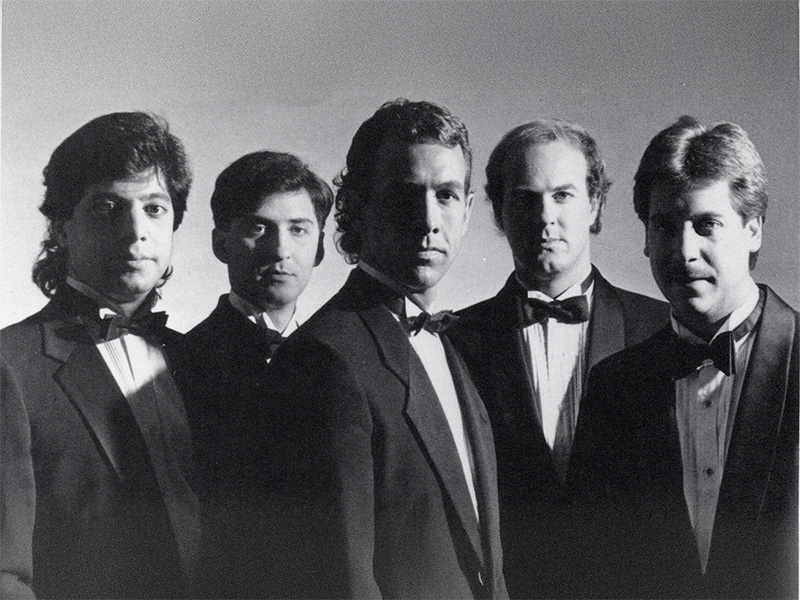
1990 Chamber Music Competition

April 2, 1991

Stephen Paulus composed more than 600 works across opera, choral, orchestral, and chamber genres. A University of Minnesota graduate, he held residencies with several American orchestras and received Guggenheim and National Endowment for the Arts fellowships. His Prayers and Remembrances won the 2016 Grammy for Best Contemporary Classical Composition.
Paulus's program note describes a concerto for the full quintet and for soloists and smaller combinations within it.

Stephen Paulus was an American composer whose catalogue encompasses more than 600 works for opera, chorus, orchestra, chamber ensemble, solo voice, piano, organ, and band. He earned his doctorate at the University of Minnesota and began a long association with Opera Theatre of Saint Louis in 1979. Over his career he composed twelve operas and fifty-five orchestral works. He held composer residencies with the Atlanta, Minnesota, Tucson, and Annapolis orchestras, and received fellowships from the Guggenheim Foundation and the National Endowment for the Arts. His collaborators included conductors Osmo Vänskä, Kurt Masur, and Leonard Slatkin. His choral work Prayers and Remembrances received the 2016 Grammy Award for Best Contemporary Classical Composition after his death in 2014.
Concerto for Brass Quintet is cast in three concise movements. The musical material treats the ensemble as a virtuosic unit and also features solos, duos, trios, and quartet combination from within the group.
Movement 1 (Dramatic) opens with a repeated chord which expands immediately in duration and intensity. A rapid eighth note section follows in which there is a lively interchange of tense melodic fragments among all of the instruments.
Movement 2 (Pensive) begins with an extended horn solo - a theme which appears in various guises throughout the movement. The somewhat mournful opening is followed by another main thematic idea - a lighter and more playful fragment in waltz-time.
A pyramid of notes ushers in the third movement (fiery). This is again followed (as in the first movement) by a rapidly moving eighth note section. This time, though, the harmonic palette is one of constantly shifting tonalities rather than curt melodic fragments. The pyramid note motif is woven throughout and often erupts into miniature "explosions" of notes which cascade and propel the work to an effervescent close. - Stephen Paulus

