
1982
for
Two violins, viola and cello
Richard Wilson

Muir String Quartet
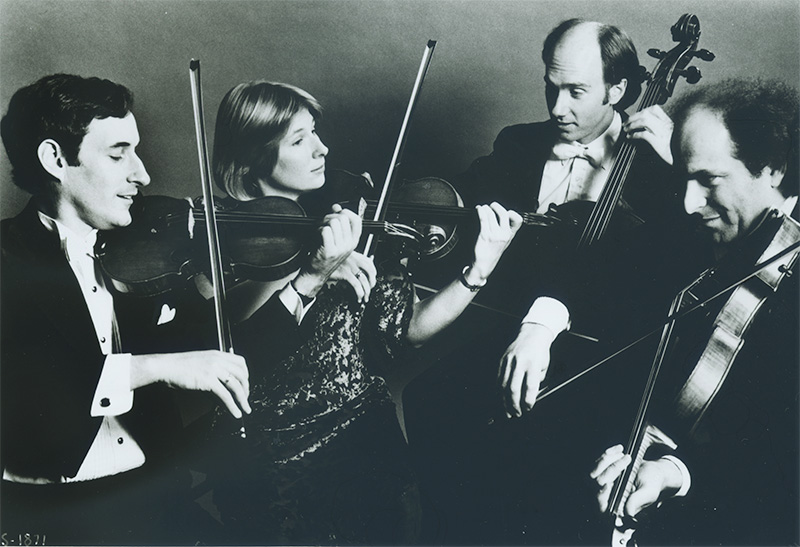
1981 Chamber Music Competition

April 26, 1983

Richard Wilson is a composer and pianist, Professor Emeritus of Music at Vassar College, and a longtime composer-in-residence with the American Symphony Orchestra. His catalogue includes symphonies, string quartets and the opera Aethelred the Unready. His honors include a Guggenheim Fellowship and the Stoeger Prize.
Wilson links the arch-shaped Prelude, the scherzo-and-march character of Episode, and the concluding Elegy through clear formal designs and the change from the opening movement’s C foundation to the finale’s C-sharp.

Richard Wilson is an American composer and pianist whose catalogue includes symphonies, string quartets, chamber music and the opera Aethelred the Unready. He studied at Harvard with Randall Thompson and Robert Moevs and taught for more than fifty years at Vassar College, where he is Professor Emeritus of Music. Wilson has received commissions from the Naumburg, Koussevitzky and Fromm foundations, the San Francisco Symphony and the Library of Congress. His awards include a Guggenheim Fellowship, the Stoeger Prize and an award from the American Academy of Arts and Letters. He became composer-in-residence with the American Symphony Orchestra in 1992. His orchestral music has also been performed by the London Philharmonic and Jerusalem Symphony.
"Each of the three movements of my String Quartet No. 3 bears a title and exhibits a perceptible formal design. The first is called, Prelude, not only for the obvious reasons, but because its prominent pedal point - the cello's C string - gives rise to a particularly anticipatory feeling. It may also be that in giving this movement a title, I thought of preludes of Bach and thier lavish pedal points. This movement resembles an arch. At its center is a section that builds up in stages to a dynamic high point. Before and after are passages making use of the cello's pedal point. Surrounding these passages are related outer sections: at the opening, a duet between the second violin and viola with plucked punctuation from the cello; and at the closing, an expansion of this music involving all four players to form a gentle code. The second movement takes the name Episode because it acts as a dramatic interlude at a certain remove from the main line of the work. Its character is a blend of scherzo and march. Like those forms, amd unlike the first movement, Episode has sharply articulated sections. These may be understood as ABA'B' show interruptions, intercalations, and elaborations of the original statements. With the concluding movement, Elegy, the slow harmonic motion of Prelude returns but instead of cold, open-string pedals there appears as underpinning the vibrant stopped note, C-sharp, which creates a relationship wherein the first movement acts as leading tone to the third. The Elegey is a refrain-dominated piece that is deeply serious in tone and manner.
String Quartet No. 3 was commissioned for the Muir Quartet by the Walter W. Naumburg Foundation. It is dedicated to th members of the Muir and to Leon Botstein. The Muir gave the first performances at Yale and Vassar in April 1983."