
1975
for
String Quartet
Claus Adam
American String Quartet

1974 Chamber Music Competition


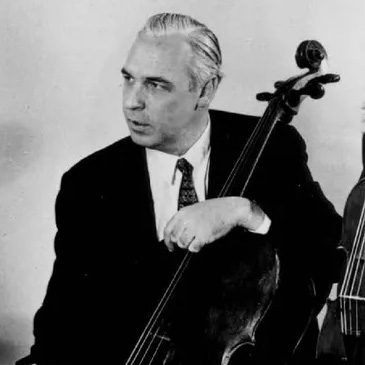
Claus Adam combined a distinguished career as a chamber cellist with composition and teaching. A longtime member of the Juilliard String Quartet, he taught at Juilliard and Mannes. His works include a cello concerto, string quartets, orchestral music and a piano sonata.
Summary of Adam’s note: Two contrasting parts are linked by shared material; altered string tunings broaden the quartet’s palette in the second part.

Claus Adam was a cellist, composer and teacher whose performing life was closely connected with American chamber music. He spent seven years in the New Music String Quartet and nineteen in the Juilliard String Quartet, turning increasingly to composition after leaving the latter ensemble. He taught at the Juilliard School and Mannes College of Music and served as music administrator of the National Orchestral Association. His Cello Concerto, commissioned by the Ford Foundation, was introduced by Stephen Kates with the Cincinnati Symphony. A Guggenheim grant supported his 1976 residency at the American Academy in Rome. His output also includes orchestral music, string quartets and a piano sonata.
"The String Quartet '75 is actually my second quartet, while the first was an earlier attempt performed by the Juilliard String Quartet in 1949 for ISCM long before I had become the cellist of the Ensemble. The work is clearly organized into two parts. the first part begins with a Lento tranquillo, shifts into an Allegro inquieto in free sonata form, then transitions into a Largo doloroso - forming a large emotional arc.
The second part employing scordatura - an alternate tuning technique, unusual for modern compositions, where strings are "mistuned." (Scordatura was commonly used in the 17th and 18th centuries. Other examples can be found in the music of Biber, Tartini, Bach, Paganini and Mahler, in Kodaly's solo cello sonata.)
In the Moderato statico=presto misterioso, pizzicatos and natural harmonics are employed but fingered without ever pressing the string down to the fingerboard. Melodic and harmonic materials from the first part are repeated and developed in the second part.
In the last section Veloce e vivace which is almost a perpetual motion at times, all the devices of the previous sections are employed plus fingering or pressing the strings down to the fingerboard to get various pitches."

