
1980
for
Two violins, viola and cello
Ben Johnston

New World String Quartet
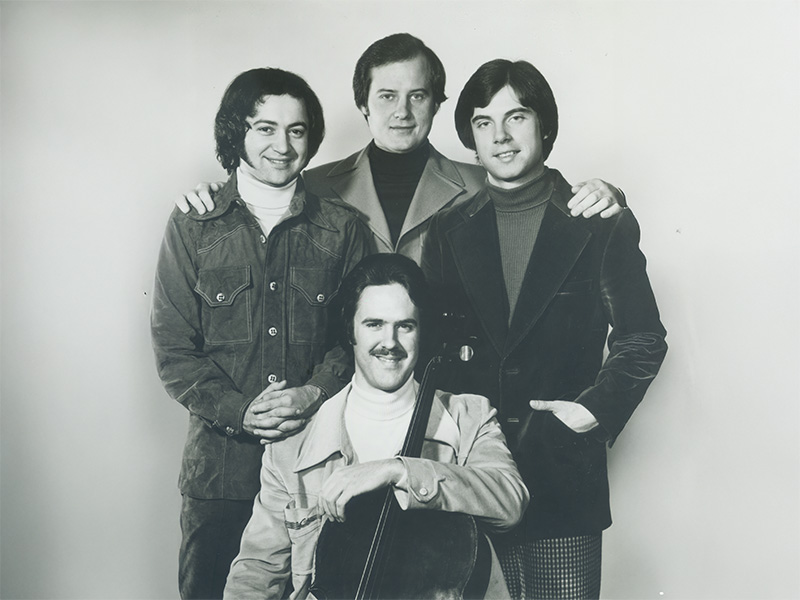
1979 Chamber Music Competition


Ben Johnston (1926–2019) was an American composer associated with microtonality and just intonation. He studied with Harry Partch, Darius Milhaud and John Cage and taught at the University of Illinois. His ten string quartets explore pitch relationships beyond the conventional twelve-note scale.
Johnston describes a study in continuous melody. Phrases flow into one another without cadences, and proportional relationships govern the solos and tempo changes as the music gradually accelerates.

Ben Johnston (1926–2019) was an American composer known for extending the possibilities of musical tuning. Born in Macon, Georgia, he began composing as a teenager and served in the Navy before studying at the College of William and Mary. He later worked with Harry Partch and studied with Darius Milhaud at Mills College. Johnston joined the University of Illinois faculty in 1951 and also studied with John Cage. He received a Guggenheim Fellowship in 1959. His ten string quartets form a central part of his output, exploring increasingly fine distinctions of pitch through just intonation and a notation devised to make those relationships practical for performers.
"In String Quartet No. 6, I undertook the problem of endless melody so fascinating to late nineteenth century composers. Since it seemed to me that this concept never really met successfully the tests to which it was subjected, I was especially anxious to make it succeed in a non-dramatic, non-programmatic context. The melodic phrases are completely elided, avoiding all cadences. The punctuation, the rise and fall, and the climax placement of these lines and accompaniments are controlled by an elaborate application of proportions from the Fibonacci series. The length of the solos and their tempos are strictly proportional and result in a gradual increase of activity up to double the initial tempo."