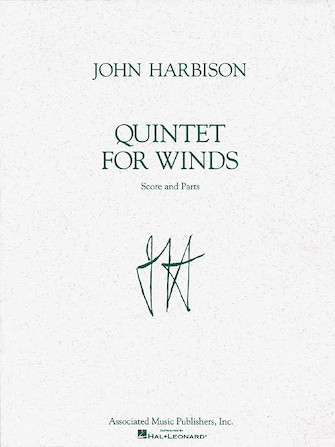
1978
for
Flute, oboe, B-flat clarinet, horn and bassoon
John Harbison

Aulos Wind Quintet

1978 Chamber Music Competition


John Harbison is a composer, conductor and pianist whose works include operas, symphonies, concertos and chamber and sacred music. Educated at Harvard and Princeton, he has had a long association with MIT. He received the 1987 Pulitzer Prize for The Flight into Egypt and a 1989 MacArthur Fellowship.
Harbison describes a work concerned with instrumental mixtures and doublings. He sought a clear musical surface that would make the most of the wind quintet’s distinctive colors, despite the considerable technical demands on its players.

John Harbison is an American composer, conductor and pianist whose catalogue spans opera, symphonic and chamber music, song and sacred works. Educated at Harvard and Princeton, he joined the Massachusetts Institute of Technology faculty and became an Institute Professor. His music has been commissioned by the Metropolitan Opera, Boston Symphony, Chicago Symphony and New York Philharmonic. Harbison received the Pulitzer Prize in 1987 for The Flight into Egypt and a MacArthur Fellowship in 1989. He has been composer-in-residence with the Pittsburgh Symphony and Los Angeles Philharmonic, and led Tanglewood’s composition program from 2005 to 2015. An active jazz musician, he has also written jazz compositions and arrangements alongside his concert works.
Quintet, the Naumburg Foundation commission, was a welcome opportunity, because I admired Aulos’s playing, because I had been writing a string of impractical pieces, and because I regarded the writing of a quintet for woodwinds as challenging. It is not a naturally felicitous combination of instruments, such as a string quartet. I was determined to deal in mixtures rather than counterpoints, and to strive for a classical simplicity of surface – to maximize what I felt to be the great strength of the combination, the ability to present things clearly. The piece especially emphasizes mixtures and doublings and maintains a classically simple surface. It is extremely challenging to play, and one of the principal rewards of the piece has been the opportunity to work with a number of resourceful, inquisitive, and fearless wind players in the mutually beneficial expansion of their repertory.
Ever since Marsyas, a flute-playing satyr engaged in competition with the string player Apollo, was flayed alive for being unable to sing and play at the same time, wind players have been sentenced to forage in a sparse and undernourished musical literature. Now things are changing. Wind players, forced to be part of the musical present, are shaping a future for themselves through their energy and advocacy of new compositions. The collaboration with the Aulos's Quintet has been rewarding, composer and performer enjoying and needing each other’s skills. Aulos's Quintet gave the first performance in Boston’s Jordan Hall on April 15, 1979, and subsequently recorded it for CRI. The piece has been performed by many groups – most notably the Emmanuel Wind Quintet, who have performed it over forty times and gave the first New York City performance in 1980.